Most parents bring their child to an orthodontist when the crowding becomes obvious — usually around age twelve or thirteen, once all the permanent teeth have come in and the problem shows up in every photograph.
By then, some of the most useful treatment options have already closed.
The recommendation from orthodontic specialists worldwide is a first evaluation at age seven. Not braces at seven — an evaluation. That distinction is the source of most of the confusion parents have about this.
Why age seven?
Seven is not an arbitrary number. It is the point at which a child's mouth first reveals enough to be read properly.
By this age the first permanent molars have usually erupted, establishing the back-tooth relationship that determines how the bite will develop. The permanent front incisors are coming through, making crowding and protrusion visible. And critically, the jaws are still growing — which means their growth can still be guided.
That last point is the whole argument. A narrow upper jaw or a lower jaw positioned too far back is far easier to influence while the bones are still developing than after growth completes in the mid-teens. The correction that takes a simple appliance at eight can require extractions at fourteen, or jaw surgery at twenty.
Most children need nothing at this visit
This is worth saying plainly, because parents often avoid the appointment expecting to be sold treatment.
The large majority of children evaluated at seven need no treatment at all. They are placed on periodic observation — a short review every six to twelve months to track growth and eruption — and the family is told when, or whether, to expect treatment later. That observation has real value: it means the right window is not missed, and treatment when it comes is planned rather than reactive.
Signs that warrant an evaluation
Some situations warrant a look sooner, or make the age-seven visit more urgent:
If you have noticed any of these, an evaluation is worth booking regardless of your child's age.
Phase One and Phase Two treatment
When early treatment is recommended it usually follows a two-stage structure, which parents find confusing at first.
Phase One
This happens roughly between ages seven and ten, while baby and permanent teeth are both present. It addresses skeletal and space problems rather than tooth alignment — expanding a narrow jaw, correcting a crossbite, creating room for permanent teeth, or stopping a habit that is deforming the palate. It typically runs six to twelve months and often uses a removable appliance or expander rather than full braces.
Phase Two
After a resting period during which the remaining permanent teeth erupt, Phase Two begins in the early teens. This is conventional braces or aligners, aligning the teeth and finishing the bite.
Not every child needs both phases — many need only Phase Two. The point of early evaluation is to determine which category your child falls into. Phase One is recommended only when it genuinely prevents a harder problem later.
What waiting can cost
Delaying is not neutral. Three consequences come up repeatedly:
Extractions that could have been avoided. A jaw expanded at eight often accommodates all permanent teeth. The same jaw at fifteen may require removing healthy premolars to create space.
Impacted canines. Upper canines erupt late, around twelve. If crowding blocks their path they become trapped in the bone, requiring surgical exposure. Detected early, space can be preserved so they erupt normally.
Surgery instead of growth guidance. Significant jaw discrepancies can be modified while a child is growing. Once growth completes, the same discrepancy may need orthognathic surgery.
What happens at the first visit
For a seven-year-old the appointment is straightforward and painless — worth telling your child in advance, because anxiety about the unknown is usually the bigger obstacle.
The orthodontist examines the teeth, jaws and bite, and observes how the jaws move and meet. An OPG X-ray is usually taken to show the permanent teeth still developing inside the bone, their position and their eruption path. This is often the most informative part of the visit, because it shows what is coming before it arrives.
You will then be told one of three things: development is normal and no follow-up is needed for a year; something needs monitoring, with a review schedule; or there is a specific issue where early intervention would help. No treatment starts at a first evaluation — you leave with information and time to think.
Frequently asked questions
Book an evaluation
If your child is around seven, or you have noticed any of the signs above at any age, an evaluation is a short appointment that either gives you reassurance or gives you time.
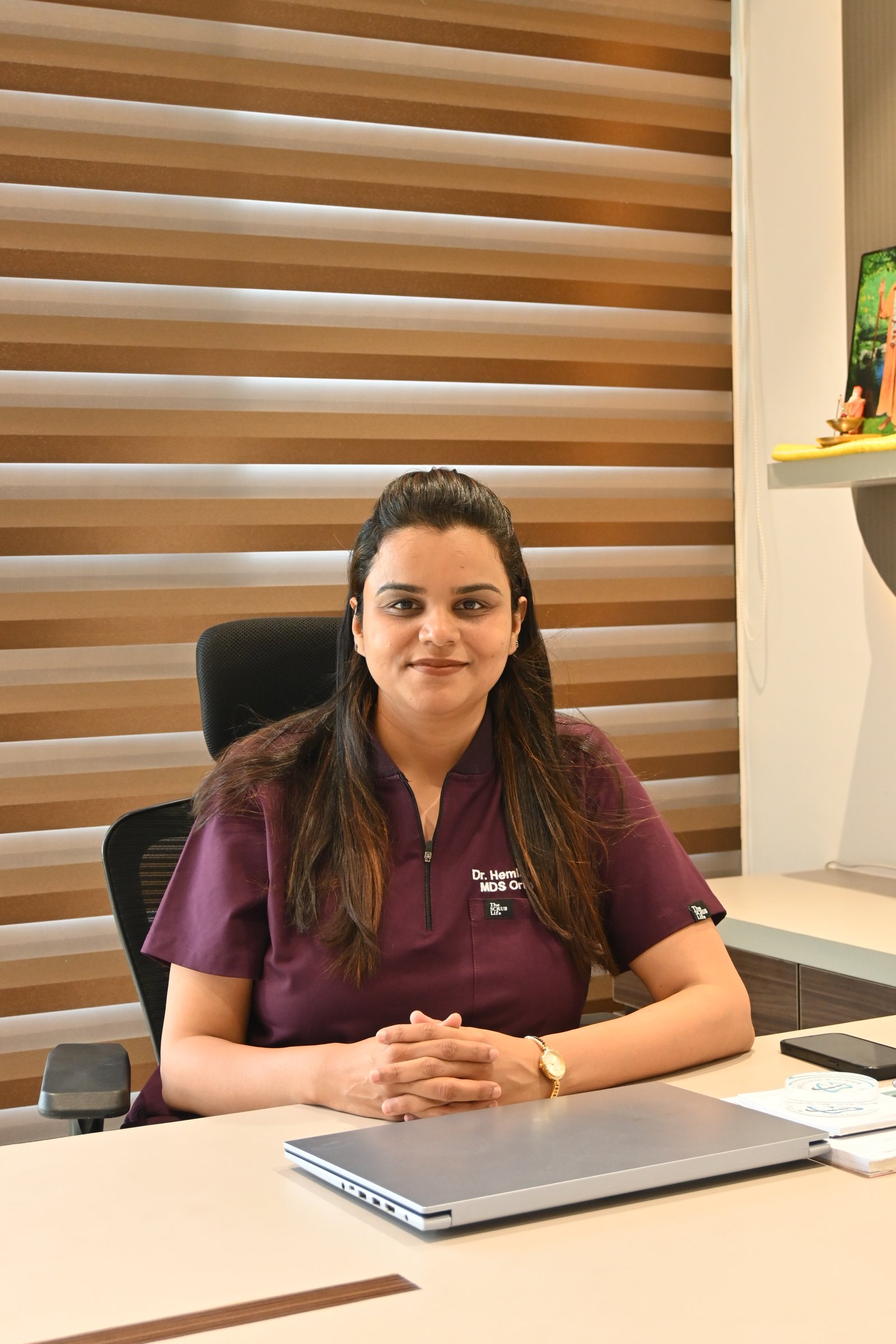
Dr. Hemlata Tanwani (MDS – Orthodontics & Dentofacial Orthopaedics) has practised orthodontics exclusively for over fifteen years, completing more than 1,500 cases for children, teenagers and adults across Wakad, Hinjawadi and PCMC. The clinic has in-house OPG imaging, so diagnosis happens in the same visit.
Dr. Tanwani's Braces & Dental Clinic — Office 303, 57 Avenue, Shivraj Nagar Road, Shankar Kalat Nagar, Wakad, Pimpri-Chinchwad 411057. Five minutes from Hinjawadi Phase 1.
In-house OPG imaging available for same-visit diagnosis.